Showing posts with label kids in the kitchen. Show all posts

Monday, December 31, 2012

Pancake Challenge: Day 12

Name Pancakes

Important note about raising (a) child(ren):  Get help.  Lean on family, and if you don't have one, make one.  Same for friends.
Then you have more energy to be there for your kid(s) and later on, for your friends and family, rather than going out hard at the start and burning out spectacularly (or even slowly and insidiously).

And in that spirit...

I have a guest pancake maker today (and maybe for a few more days).  Gramma S - one of T's 4!  Lucky BOY!

And now;

The secrets of the best name pancakes.

1.
Write the letters backwards,
so when you flip them over...
2.
they are right-way-'round.

(I admit E is funny, because I photographed
sorta' upside down.)  And A is always correct.
A great lesson in symmetry, Name Pancakes are.    

3.
Apply the Topping-of-Your-Choice.
3a. No pressure.  Of course on photographing day the Name Pancakes proved a bit runny and misshapen.  But who cares?  They are still tasty as heck!

Monday, December 3, 2012

Teach Pie Early!


Growing up - come Thanksgiving time - the Pumpkin Pie was MINE!  I'm unsure how this tradition started, but it is still here.

Partly, it may have to do with how much I loved eating the raw pie crust, but that's another story.  Functionally it comes down to the fact I started making pie crust before I was mentally equipped to be nervous about the results.  I was just experimenting.  (OK, maybe I never got over that).  But because I was just playing around, I had the time to do it wrong on the way to right.

 That was true for the pie filling as well.  There was the year I left out the eggs.  OOPS!  But my mom simply decided that year the pie was sauce for the ice cream.  It wasn't ruined, it was just different.  It still tasted great, the form had just changed.  (Part of me thinks that was key in my continued kitchen exploration - step 1: make it taste good.  The rest is details.)


But back to the crust.  Because I started working with pie crust before I knew it was an object of fear and loathing, I've never really had trouble with it.  In fact, one year at camp they had a pie making contest and I busted out an apple pie off the top of my head.  

So with that in mind, it was High Time for the offspring to learn pie crust.  A valuable skill out there in the big bad world.

So what makes pie crust (and thus pie) so easy AND so hard?  It is simple - but needs to be adjusted by experience.  It's not a hard and fast ratio like water (H2O - Always 2 hydrogens to 1 water - no matter what).  It is close to a hard and fast ratio - start with 2 C flour and 1 of fat - but then it needs a little adjustment, a little water, don't forget the salt.

And less is more.  Manipulate it less.  Overworking it makes a rock hard crust.  Walking away when it seems sort of unfinished is the key.  And use your hands.  Get floury and buttery.  The crust will come out better for it.

And the key of all keys.  Wrap it and let it rest.

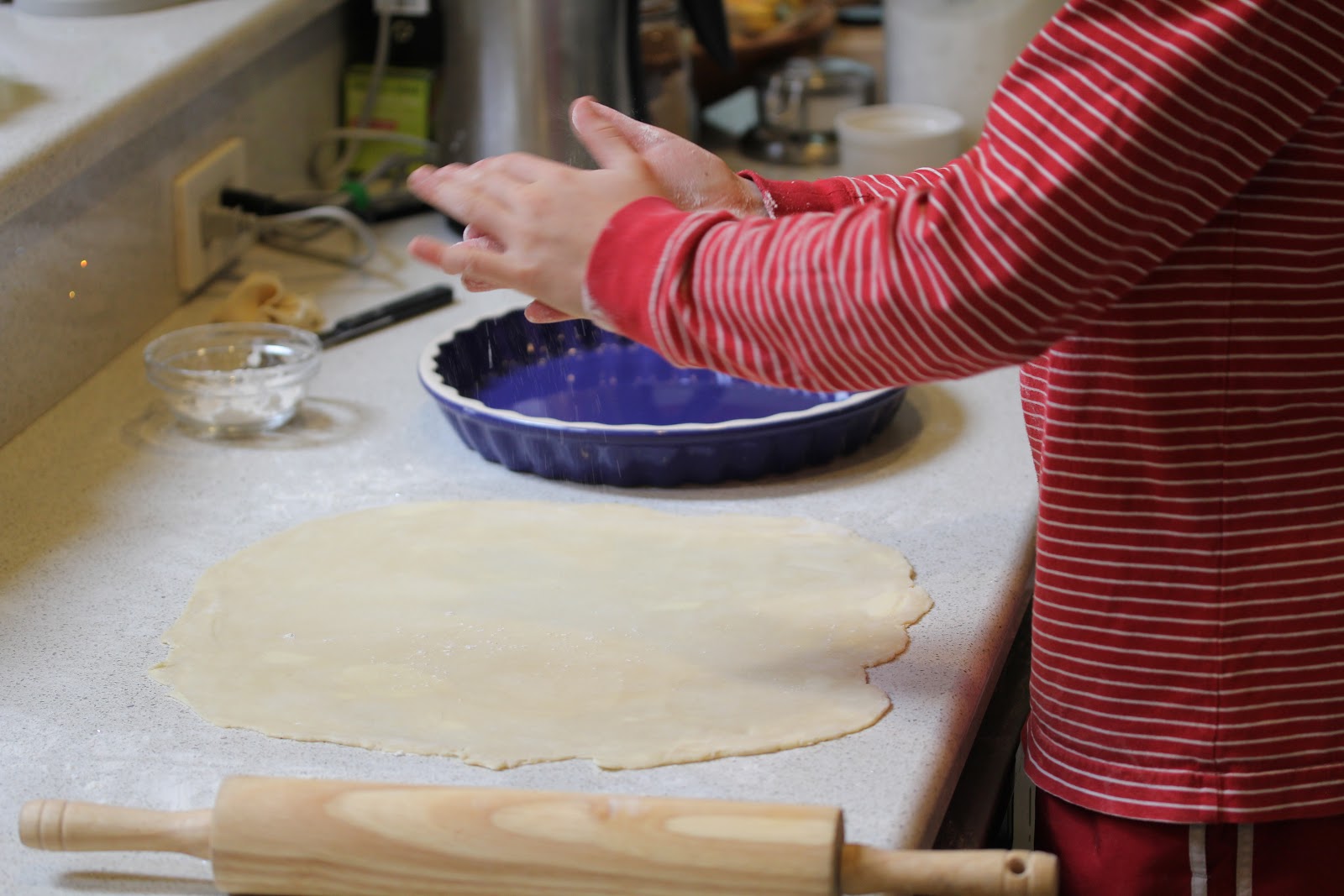
Because if you do that - then your child(ren) can learn to do this:


Oh - and Julia Child's kitchen wisdom recipe (more or less)

For 2 9(ish) inch Pie Crusts

Equipment: 
large bowl
2 butter knives or a pasty cutter
clean hands
square of plastic wrap/wax paper/produce bag/tea towel
very clean, dry counter

And later - 
rolling pin
2 9-ish inch pie pans

Ingredients:
2C flour - if you have it, use 1/2C cake flour and 1.5C AP flour, but don't sweat it if you don't.
1C cold butter (that's 8oz or 2 sticks) Lots of people (inc. JC) swear by 4oz butter + 4oz vegetable shortening or lard.  That works great too, but again what you have is what works best.
1 Tbs + ice water
1tsp salt

Prep:
Scoop up 1 heaping cup of flour.  Level it off with a butter knife.  Dump it into the bowl.  Repeat to get 2 cups of flour.
Pour the flour into a large bowl
Add the salt and stir it in.
Chop the butter (or butter/shortening mix) into large pea sizes.
Dump them into the flour and proceed to cut the butter into smaller and smaller pieces - until the flour looks like coarse corn meal.  Add in the 1 Tbs of ice water - dribbling it all around the flour.
(Can also have the food processor do the above cutting/mixing.) 
Using clean hands, squish the whole thing into a ball, and dump it onto the counter.
Use the heel of your hand to push out a portion of the dough into a "tongue".  Pull it back in.  
Do this about 5 times to get all the loose flour incorporated (more or less).
Smoosh it all back together, cut it in half, and pat together into 2 disks about the size of the circle you can make with your 2 hands together.  Wrap it up.
Let it rest for at least 30 min in the fridge.  Or up to 2 days.  If its going to hang out any longer than that - freeze it.
Roll it Out:
Let fridged dough sit on the counter for 1-5 min (depending on how long its been in there).  Frozen dough needs a solid hour on the counter - or just remember to thaw it in the fridge the night before (I know - I crack myself up sometimes).


Sprinkle flour on the clean, dry counter top, (or a very smooth tea towel), rub some on the rolling pin (device), and get plenty on your hands.  Have flour out to keep things unsticky.  As long as your sprinkle lightly, don't worry about using too much.

Roll out the pie dough.
Sprinkle flour on the clean, dry counter top, (or a very smooth tea towel), rub some on the rolling pin (device), and get plenty on your hands.  Have flour out to keep things unsticky.  As long as your sprinkle lightly, don't worry about using too much.


Try to roll up and down.  Then turn the dough 90˚ (1/4 turn).  
Flip, do this to the other side.  This will keep the dough in a basically circular shape (a rounded rectangle) and fairly even thickness.


Repeat until it is quite a bit bigger than the pie plate - giving room for the pie crust to come all the way up the sides and drape over the edge.


When it's big enough - with floury hands - lift it into the pie plate.  Jiggle it down and either drape it over the edge and cut off the excess.


 If you are feeling fancy, you can pinch the extra into fluted edge - then cut off the extra extra, or even cut out leaves or other shapes and place them around the edge.


Fill it with sweet or savory!


Saturday, September 3, 2011

Some things (parents of) kids should know....

Welcome to the recovery version....

I know I'm all about the fresh food, and the cool food project, and the Farmer's-Market-this and CSA*- that, but there are plenty of days I am Glad Glad Glad we live in a world where easy, shelf stable food exits.

It is in my emergency kit, and it is in my pantry.  And there are times that sort of feel like an emergency, and that is when they come out.
So when I went down with Strep Throat this weekend, I was really glad the supplies were there, and my son could cook his own dinner.
Was it pretty?  No.
Was it even gourmet?  NOPE.
But it was kindof nutritious, it was kindof balanced, and he was able to do it *all by himself.*
It was microwave mac 'n cheez & a cucumber.

The 2 great things about this -
1. He had done this enough, so he could do it himself, and
2. I had a fresh thing on hand he wanted enough to hunt out and eat.  (He said it was fun just biting into a cucumber - something to think about in our bite sized world.)

The key is, we should eat real food more often than we do, and my goal is to help make it easy, tasty and fun, and something anyone can do.
But I'm no hater.  Shelf stable food has an important place in our just-in-time society.  Emergency rations, travel food, winter food... there are reasons for it - we just shouldn't eat it all the time.... And so much of it.

Which brings me to the second thing - teach your kids how to make a toasted cheese sandwich and/or quesadilla, and then have them make them.
(And then make them clean up.)

The sooner they feel like they can feed themselves, the sooner they will, and if they get used to feeding themselves in your kitchen, you can help them decide what kind of food will be in their kitchen, and what kind of food they will cook.  If we never put them in a position where they need to cook they certainly won't know what to do when they have to.

My learning to cook story isn't particularly special, except I was allowed to try things.  Oh yeah, and if something didn't taste good I was told so.  Because there was "Yuck!" I knew I could trust "Yum!"
Kids know when they are being lied too - they just play along, but it makes it hard for them to know when you are telling the truth.  And if you tell them something they made doesn't taste good when they are young, they'll bounce back - but if it doesn't happen until they are a teenager - Watch Out.  There will be splatters.

(I heard Michael Pollan of _Omnivore's Dilemma_ on NPR talking about shopping for Fruity Pebbles for his son.)

*Community Supported Agriculture

Wednesday, September 22, 2010

It's All Worth It!

Had another of those moments.  You know the ones, where up until it happens, all the years where I've been slaving away with no recognition, and a dwindling hope of ever seeing any returns to the hours and hours I've spent on a project seem wasted.  And then suddenly, the light breaks through.  Your son spontaneously asks if he can help with dinner.  And the help he gives actually makes dinner prep shorter, instead of longer.

If I'd known it was coming I would have arranged a party.  Instead we got to sit down to dinner at least 15 minutes sooner than I had thought, and got to enjoy a nice leisurely dinner.

Sure, now, it doesn't sound like much.  But I have spent the last 7 years or so cooking around and with my son.  Up until now, involving him has always made things take longer.  He has either needed my help all the way through a process, or needed help completing each step, and guidance on to the next.

The colander was in the sink before I needed it, the Parmesan cheese made it on to the table with out me having to do it, he poured his own milk, and the lettuce was washed and torn into the salad for me.

I have high but realistic hopes.  This won't be a regular feature.  That would make it a job, not an adventure.  But when I need him, he can pitch in, and make the impossible more likely.  And when it is his turn to venture out into the big bad world, he'll already have some practice in the care and feeding of himself.

Good One Kiddo.